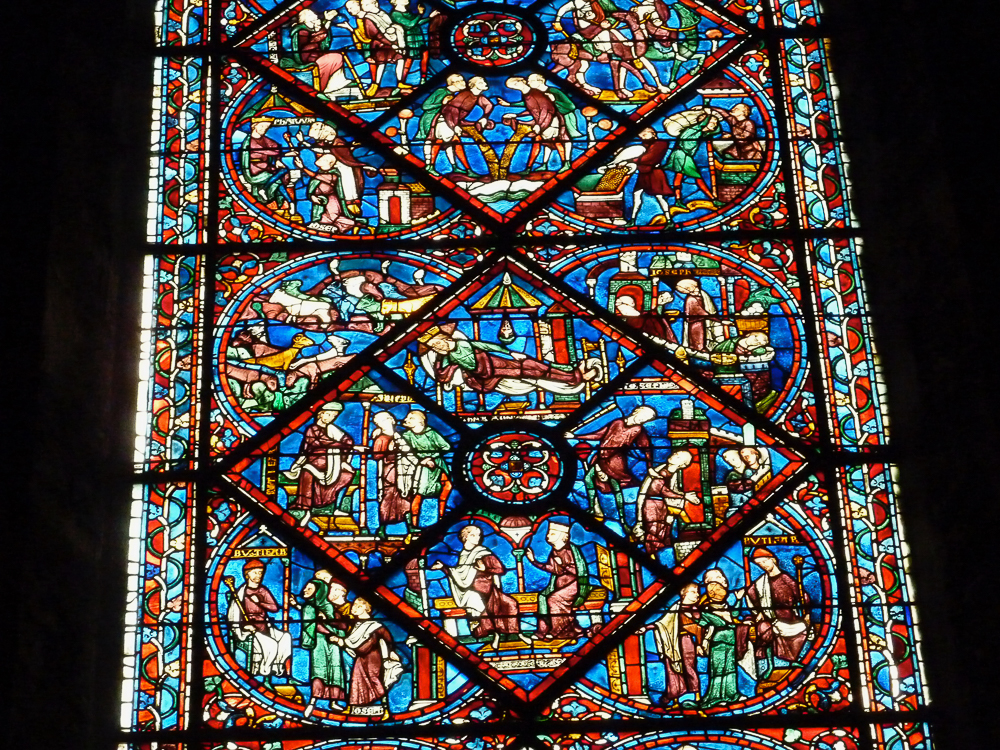
• Row 06: Sold to Potiphar; Potiphar's wife tempts him • Row 07: She accuses him to Potiphar. • Row 08: Potiphar arrests Joseph; Has him thrown into prison. • Row 09: Pharaoh dreams • Row 10: Seven fat sheep, seven thin cattle of Pharaoh's dream; Meanwhile, in prison, Joseph interprets dreams of cupbearer and baker. • Row 11: Joseph interprets dream, made governor; Graineries are filled for lean times. • Row 12: Egyptians pour grain into Nile. • Row 13: Jacob sends sons to Egypt looking for food; They travel to Egypt.
Top to bottom, left to right [See diagram for the proper order of reading.]
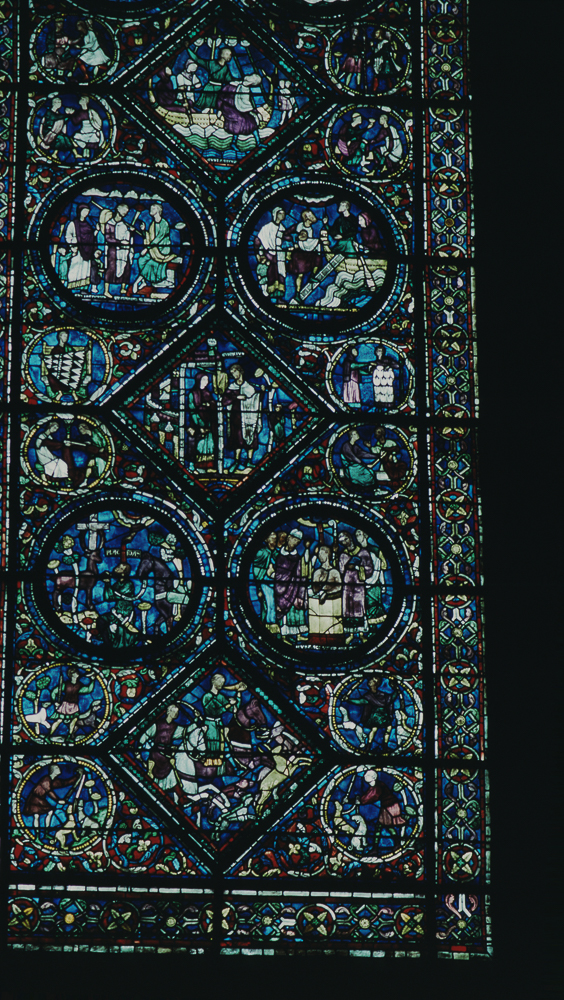
• Row 01: Wheelwrights, carpenters, coopers (barrel-makers) as donors. See also donors in the very small squares bottom left and right. Perhaps appropriate given the ark's water-tight construction of wood.... • Row 02: Giants, sons and daughters of men; Giants, sons and daughters of men [see Genesis 6:4, the 'Nephilim']. • Row 03: Giants, sons and daughters of men; God talks to Noah; Giants, sons and daughters of men. • Row 04: Noah's three sons: Shem, Ham, and Japheth; Noah's wife and daughters-in-law.
† Window 145 - North rose: Rose of France glorifying the Virgin (unrestored)
Virgin in center with Infant Jesus. Surrounded by four doves, four angels, and four Thrones. These are followed by twelve kings of Judah, Mary's ancestors. The outer ring contains twelve minor prophets.
The window was donated while Queen Blanche was regent of France (circa 1230). The arms of France alternating with Castile are seen below the rose itself. The entire ensemble is a none-too-subtle bit of royal propaganda, with Mary (the Queen of Heaven) at the center of it all. Note too that the figures below the rose in the lancets contrast a legitimate righteous sovereign with corrupt, foolish, or fallen ones. Blanche seems to have wanted no doubt about how she ought to be considered.
†North side, lancets, left to right: True versus false sovereigns (unrestored)
• Window 145C - North side, far left lancet: Melchizedek standing over Nebuchadnezzar (true king over the false Babylonian pretender to world-lordship, worshipping idol of his dream).
• Window 145B - North side, near left lancet: King David standing over King Saul (the chosen king over the apostate king rejected by God, who dies via suicide in despair).
• Window 145A - North side, central lancet: Saint Anne holding Infant Mary. Beneath this are the arms of France.
• Window 145D - North side, near right lancet: Solomon over Jeroboam, who worships golden calf (wise king over the fool who worshipped idols and abandoned the LORD).
• Window 145E - North side, far right lancet: Aaron above Pharoah, covered by the Red Sea (true priesthood and power over the false).
Window 059 - Symbolic Window, Typology of the Passion of Christ (unrestored)
NB: Read TOP to BOTTOM, unlike most windows. Some are modern (marked *).
• Row 06: Moses shows brass serpent; Adam collects blood at the foot of the cross (*); Israelites mark their doorposts with blood of the lamb (tau). • Row 05: The Church (the NT, new faith); Crucifixion with Longinus and Stephaton (*); Synagogue (the OT, old faith). • Row 04: Gideon sees angel (*). • Row 03: Christ is mocked and crowned with thorns; Israelite scouts return from promised land with evidence of its richeness; The Scourging of Christ. • Row 02: Women weep at the Crucifixion; Jesus carries the cross (*); Soldiers preparing for the crucifixion. • Row 01: Christ (with candelabra) (*).
† Window 145 - North rose: Rose of France glorifying the Virgin (restored)
Virgin in center with Infant Jesus. Surrounded by four doves, four angels, and four Thrones. These are followed by twelve kings of Judah, Mary's ancestors. The outer ring contains twelve minor prophets.
The window was donated while Queen Blanche was regent of France (circa 1230). The arms of France alternating with Castile are seen below the rose itself. The entire ensemble is a none-too-subtle bit of royal propaganda, with Mary (the Queen of Heaven) at the center of it all. Note too that the figures below the rose in the lancets contrast a legitimate righteous sovereign with corrupt, foolish, or fallen ones. Blanche seems to have wanted no doubt about how she ought to be considered.
†North side, lancets, left to right: True versus false sovereigns (restored)
• Window 145C - North side, far left lancet: Melchizedek standing over Nebuchadnezzar (true king over the false Babylonian pretender to world-lordship, worshipping idol of his dream).
• Window 145B - North side, near left lancet: King David standing over King Saul (the chosen king over the apostate king rejected by God, who dies via suicide in despair).
• Window 145A - North side, central lancet: Saint Anne holding Infant Mary. Beneath this are the arms of France.
• Window 145D - North side, near right lancet: Solomon over Jeroboam, who worships golden calf (wise king over the fool who worshipped idols and abandoned the LORD).
• Window 145E - North side, far right lancet: Aaron above Pharoah, covered by the Red Sea (true priesthood and power over the false).
• Corners 1: Butchers, donors of the window [13th century] • Quatrefoil 2: Mary (12 o'clock), with stonecutting and hauling for cathedral (3 and 9 o'clock), Chartres cathedral south tower (center), wine for workers (6 o'clock) [13th century]
†Central Diamond 1: Placidas hunts a stag. • Row 1: Part of the hunt. • Row 2: Part of the hunt. • Row 3 (two circles): Sees crucifix between stag's antlers; Placidus chooses to be baptized a Christian, and receives the name Eustace. • Row 4: Drapers, as donors. • Row 5: Furriers, as donors.
† Central Diamond 2: Eustace leaves city with wife and children. • Row 6 (two circles): Negociates for passage on ship and sails to Egypt (2 panels).
† Central Diamond 3: Eustace and children driven from the boat, while boat captain retains his wife [story continues in row 9].
• Row 7: Eustace's two sons meet and recognize each other; Eustace converses with the emperor's messengers and they realize he is Placidas whom they have been sent to find [story continues row 10]. • Row 8: Emperor Trajan sends for Placidas (now Eustace); The messengers lodge with Eustace without recognizing him [story continues in row 11, right].